

The conference opened with short addresses from a European and an American – Czech Senate President Miloš Vystrčil and US Ambassador to Czechia Nicholas Merrick. Each of them spoke about how important it is for Europe and the United States to exist alongside each other peacefully, without any groups taking advantage of one another. As this year’s theme was Europe and United States: One Future? ; having both a European and American voice was key to a proper to beginning of the conference.
Finland’s former prime minister Mari Kiviniemi highlighted that now more than ever, diplomacy is
needed in this political climate. Maroš Šefčovič spoke similarly to Kiviniemi, how the US and Europe’s transatlantic bond is natural and benefits both sides, but for each side to cooperate, they must be individually united and stable.
Economist Jan Švejnar talked about the different economies of America and Europe during his fireside chat. Both regions are able to learn from one another economically. “In this regard, the United States serves as a great example of a union where you can easily scale, hire, invest across 50 states. We want exactly the same for Europe,” says Švejnar.
The first panel was about business and competitiveness, focusing on the central theme of ‘shaping a common Transatlantic future’. James Waterworth, brought up an important point that business leaders need to not be so focused on the now – on what will happen within the next few days; but rather focus on innovating new ideas and creations that will affect the future for years to come. He said that it is important to not be ‘distracted by the news of today’, and rather to think about the results that the actions and decisions of today should be created with the mindset that they will still be effective in as much as a decade.
Europe and America compliment each other economically, as Petr Bartoň taught us. ‘The US businessmen come here to live, and European businessmen go to the US to make business.’ Additionally, Danuta Hübner brought up an interesting point that Europe has the ability to be America’s key to the Middle East as well as Asia. It is in the benefit of the majority of the world that Europe and America continue to grow their cooperation, ensuring an effective Transatlantic future for the next generations.
The education panel was about preparing the future for new styles of education. James Cairns made excellent points about the environments that children are brought up in will determine the adults that they grow into. He stressed the importance of community, creativity, and nature within the broad topic of childhood education. Braňo Jakabovič brought up the growth of technology, and how instead of letting it singlehandedly take over education, we as humans just need to help educate students on how to use it safely – as it can be a great tool in education. Technology can never replicate human skills, especially curiosity, so humans should continue to be curious and eager to learn, even beyond their childhood years.
Jozef Síkela’s talk centered around how important partnerships between countries and regions are for Europe, and that said partnerships will provide several benefits, including stability and economic growth. This cooperation is important between Europe and the U.S., but also various other nations. Tomáš Pojar said that the biggest problem when it comes to Europe and the U.S. is that the Czech economy, as well as other economies in Europe are not doing the best they can be doing, and the militaries are not able to defend themselves. Once transatlantic relations are strengthened, these problems will be alleviated in Europe.
The panel on technology, AI, and cybersecurity centered around the popular belief that Europe has significantly fallen behind the United States in regard to innovation within the technological world. Although America is surpassing Europe in this field, they aren’t doing it alone. Europe is in fact funding American tech transfer, helping them reach this point of technological development. The speakers looked at how Europe should impose regulations on AI, and whether or not it is their duty to regulate these American creations.
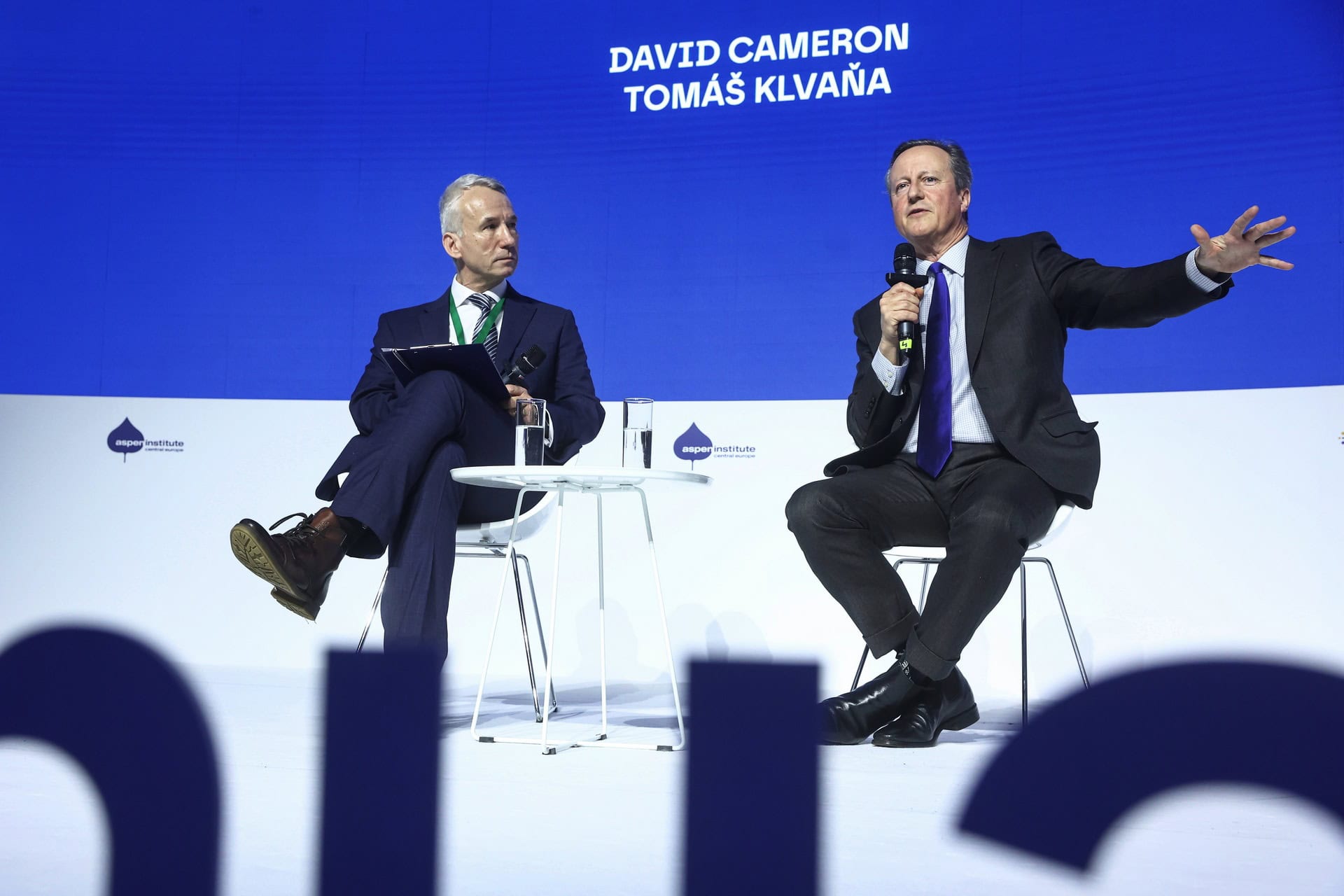
David Cameron, former Prime Minister of the UK and the prized speaker of our conference, had a wonderful fireside chat with Aspen’s own Tomáš Klvaňa. Cameron spoke about the relationship between Europe and the United States, and mentioned that he believes that while many Europeans have been upset by the current presidential administration, and while Cameron isn’t the biggest fan himself, the relationship is still benefitial to both parties: “Let’s recognize that we need to work hard to demonstrate the benefits of this relationship.”
The final panel was centered around Transatlantic energy security. Europe has become strikingly import dependent, as local refineries and chemical plants continue to shut down. “I would say that the industry that you rely on to keep the lights on and the wheels
turning and homes warm is really being hit hard. It’s been hit hard by windfall profit taxes, by
structurally higher energy prices, by carbon prices, and by a level of regulatory complexity that
adds to the cost of doing business,” said Alice Wells.
Watch the whole conference on this link!